
Data Breach Response & Incident Management Service
Fast, practical support for UK organisations after a personal data breach, unauthorised disclosure or compromised mailbox. Our data breach response team analyses the affected data to show who may be affected, what personal information was exposed and where it appears.
We work alongside your DPO, legal and cyber security teams, turning large or complex datasets into a structured evidence set for your risk assessment, ICO reporting decision and communications with the people affected.

Need to understand what personal data was exposed?
When a breach involves email accounts, shared drives, document stores or large exports, the first challenge is often working out the scale of the exposure. CCS can review the affected material and build a clear picture of the people and data involved.
- Identify affected individuals: names and other identifiers found within the breached data.
- Classify exposed personal data: including contact details, identity documents, financial information and special category data where present.
- Create a structured evidence set: document references, data categories and contact information where available.
- Work to urgent deadlines: with a defined scope, secure transfer route and named point of contact.
Get Urgent Data Breach Support
TRUSTED BY ORGANISATIONS OF EVERY SIZE



When organisations bring us in after a data breach
The common thread is the need to turn a large, uncertain dataset into clear evidence about who and what may have been exposed.
Compromised email or Microsoft 365 account
A phishing attack or stolen credentials gave someone access to a mailbox or wider Microsoft 365 environment, and you need to identify the messages, attachments, contacts and personal data they could see.
Unauthorised disclosure or misdirected data
Files, emails or records have reached the wrong recipient and the organisation needs a defensible record of the affected people, documents and data categories.
Ransomware, malware or system compromise
Once your security team has contained the incident, you need the affected or exfiltrated material reviewed to understand the personal data exposure and the likely impact on individuals.
Supplier, insider or lost-device incident
A processor or supplier has reported an incident, a member of staff has exposed data, or a laptop or phone has been lost, and you need to establish exactly which data and people are involved.
Data breach response: the key steps after an incident
Most incident response plans follow the same broad stages. This is where each one sits, and where CCS can help.
Contain the breach
Stop further loss or access: secure compromised accounts, recall misdirected data and isolate affected systems. Your IT or cyber security team leads this stage.
Assess the risk to people
Work out what personal data was involved, how sensitive it is and who it relates to. This is where CCS analyses the breached data and builds the evidence.
Decide who needs to be told
Report the breach to the ICO unless it is unlikely to result in a risk to individuals, and tell the people affected without undue delay if the risk to them is high.
Record, inform and review
Log the breach whatever the outcome, give affected individuals clear information and review what needs to change so it does not happen again.
Where CCS helps: the data analysis at stage 2, and the evidence behind stages 3 and 4, including lists of affected individuals, the categories of personal data involved and contact details where available.
The first 72 hours: what the ICO expects
Not every personal data breach must be reported to the ICO. However, organisations must assess the likely risk to people’s rights and freedoms, keep a record of personal data breaches, and report a notifiable breach without undue delay and, where feasible, within 72 hours of becoming aware of it.
If a breach is likely to result in a high risk to individuals, those people must also be informed without undue delay.
The Data (Use and Access) Act 2025 has updated parts of UK data protection law. The breach duties summarised here come from the UK GDPR, so always check the current ICO personal data breach guidance when assessing a specific incident.
Where CCS fits into the response
We work alongside the people managing the incident. Once the affected data is available for review, we can help answer practical questions such as:
- Which individuals appear in the breached material?
- What categories of personal data are present?
- Where in the dataset does that information appear?
- Are contact details available for the affected individuals?
- What evidence can be returned in a structured results sheet?
If you need ongoing regulatory and governance support around the incident, see our DPO support services. If the incident highlights gaps in your processing records, our RoPA creation and maintenance service can help rebuild that evidence base.
How our data breach analysis service works
A defined workflow keeps urgent projects moving while giving your internal team a clear audit trail.
Secure intake and scope
We confirm the systems or files involved, available exports, likely volumes, priorities, deadlines and the output your team needs. A secure transfer route is agreed before analysis starts.
Review the affected dataset
Experienced operators search and review the material using the agreed criteria, identifying affected people and the personal data that may have been exposed.
Structure and quality check the findings
Results are organised into a usable format, with document or message references, affected individuals, data categories and contact information where available. Quality checks are applied before release.
Return evidence for the response team
Your DPO, legal, security or incident team receives a structured evidence set to support risk assessment, communications, regulatory reporting and remediation work.
Our role is data analysis and personal data breach support. We can work alongside cyber security or forensic specialists, but we do not replace the technical containment and forensic investigation of an active cyber incident.
What we can identify in breached data
The review criteria are agreed for each project. Depending on the incident, this can include:
- Direct identifiers: names, addresses, email addresses, telephone numbers and identification numbers.
- Identity and account material: copies of identity documents, signatures, account details and credentials where present.
- Financial and employment information: payroll, bank details, salary or employment records.
- Special category data: health, racial or ethnic origin, religious or philosophical beliefs, political opinions, trade union membership, genetic or biometric data, sex life or sexual orientation.
- Criminal offence data: allegations, proceedings or convictions where present.
The aim is not simply to find keywords. Human review provides context, so findings can be as specific as a signature or a passport photo in an attachment, and your team knows what was actually exposed and where.
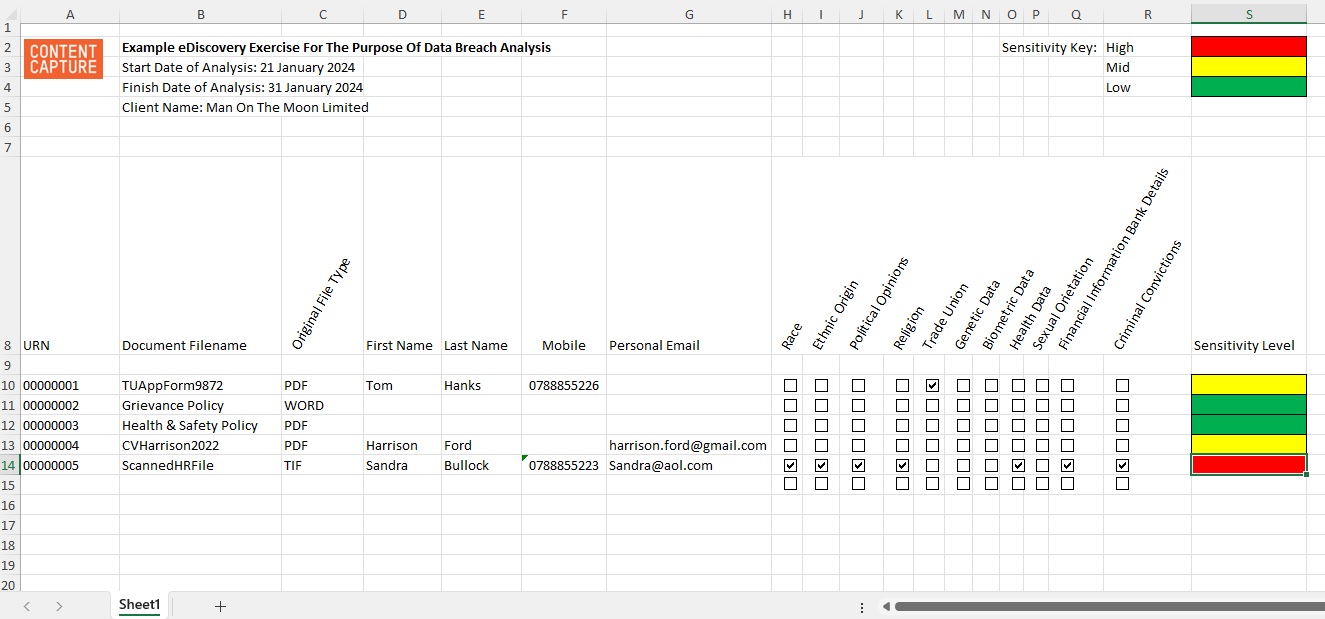
A results sheet built around your response plan
Every breach is different, so the output is agreed during scoping. A typical results set can include the affected individual, the document or message reference, the data categories identified, a short description of the exposure and available contact details.
This gives your response team a working evidence base rather than another unstructured export to review.
Why organisations choose CCS for data breach analysis
- Working with sensitive data since 1997: high-volume, confidential data projects for organisations of every size.
- Secure UK facility: project data is processed at our facility in the Peak District, with no third parties at any stage.
- Security you can check: our systems are based on ISO 27001, and we can share our security and privacy policies on request.
- Signed agreements on every project: a data sharing and processing agreement is supplied for all work.
- One named account manager: a single point of contact, agreed priorities and regular progress updates.
- Human review, not just keyword searches: experienced operators check the context, so you know what was really exposed.
Related privacy support after an incident
A breach often uncovers wider data protection work. These specialist services can help once the immediate response is under control.
- DPO Support Services for extra capacity and specialist help for your existing DPO or privacy team.
- Outsourced DPO Services if you do not have a Data Protection Officer and need ongoing compliance support.
- RoPA Creation & Maintenance if the incident exposes gaps in records of processing and data flows.
- AI Data Protection Support where the incident involves AI tools, model inputs or AI-related data governance.
- SAR Services if the breach leads to Subject Access Requests from the people affected.
- Document Redaction if breach material has to be shared and third-party personal data must be removed first.
“CCS were quick to assess our needs and completed the project ahead of time and under budget. We received a fully itemised list of all the data breaches. We were able to reach out to all concerned and make the best of a bad situation.”
Data breach analysis client
References from clients in a similar sector are available on request.
Data Breach Response & Incident Management FAQs
What is a personal data breach?
A personal data breach is a security incident that leads to the accidental or unlawful destruction, loss, alteration, unauthorised disclosure of, or access to personal data. It can include cyber incidents, lost data, mistaken disclosures and other forms of unauthorised access.
What does your data breach response service include?
Scoping the incident, a secure route for transferring the affected data, human review of the material and a structured results sheet showing the affected individuals, the personal data involved, where it appears and contact details where available. We work alongside your DPO, legal and security teams throughout.
Do all personal data breaches need to be reported to the ICO?
No. Organisations must assess the likely risk to individuals. A notifiable breach must be reported to the ICO without undue delay and, where feasible, within 72 hours of becoming aware of it. All personal data breaches should still be recorded internally.
When do affected individuals need to be told?
Where a breach is likely to result in a high risk to individuals’ rights and freedoms, the affected people must be informed without undue delay. Your organisation and its privacy or legal advisers remain responsible for that assessment and decision.
Can CCS analyse a compromised Microsoft 365 mailbox?
Yes. Compromised mailboxes and Microsoft 365 accounts are typical of the incidents we handle, alongside large email and document datasets. We agree the export, scope and review criteria before analysis starts.
What does the data breach analysis output include?
The output is tailored to the incident. It can include affected individuals, message or document references, categories of personal data found, a short description of the exposure and contact details where available.
Can you work with large data volumes?
Yes. CCS can scope high-volume review projects, including large mailbox exports and document sets running into hundreds of thousands of pages. The workflow and priorities are agreed before work begins.
Does CCS replace our cyber incident response or forensic team?
No. CCS focuses on personal data breach analysis and response support. We can work alongside cyber security and forensic specialists, but technical containment, recovery and forensic investigation should be handled by the appropriate security team.
Can CCS work with our DPO, legal and security teams?
Yes. The service is designed to provide structured evidence to the people managing the incident. If you also need ongoing privacy governance or regulatory support, our DPO Support Services page explains that separate service.
How quickly can you start?
Urgent projects can be discussed immediately. Start time depends on the availability of the affected data, secure transfer arrangements, scope, volume and deadline. We will confirm what is needed during the initial call.
What should we send you to get started?
A short summary of what happened and when, the systems or accounts involved, the approximate volume and format of the data and your deadline. If you do not have all of this yet, call us and we will help you work out what is needed.
How much does data breach analysis cost?
Cost depends on the volume and format of the data, the review criteria and your deadline. Share what you know and we will give you a quote, even if the full scope is not clear yet.
Is our data kept in the UK?
Yes. Project data is processed at our secure UK facility in the Peak District, with no third parties at any stage. A signed data sharing and processing agreement is supplied on every project.
Discuss your data breach requirements
Start with the information you have now. It helps to know what happened and when, the systems or accounts involved, the rough volume and format of the data and your deadline. If you do not have all of that yet, we can still help.
Call or email our breach response team
If the incident is urgent, talk through what happened, what data is available and the deadline you are working to.
Request a call back
Tell us when it is convenient to speak and leave a contact number. We will get in touch to discuss the incident.
Request a data breach quote
Share the systems, data volume and deadline where known. We can still help if the full scope is not clear yet.